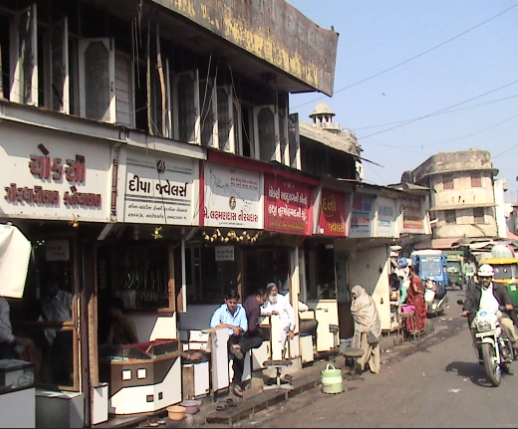
Travel through SG Highway at any time during a weekday evening, and you get to see the reality of contemporary Ahmedabad. Towering glass buildings, branded stores, valet parking, and well-lit office buildings. But just eight kilometres away from here, within the walled city of Ahmedabad, a different kind of riches is traded daily in an area known as Manek Chowk. Shops which are over a hundred years old, with wooden account books and family names inscribed above each shop door, still operate one of the oldest bourses for precious metal and jewellery in the country. Here’s why.
A Square Built for Trade, Not Show
Manek Chowk has been an area that has been serving as the commercial center of Ahmedabad since its establishment in 1411. This is a marketplace built around the Bhadra Fort, and it takes its name from Baba Maneknath, who is said to have helped Sultan Ahmed Shah I in building this fort. Originally, the square was built keeping all the practical considerations in mind, such as closeness, density, and community.
This was not only an area of legends but also an area where some very real businesses were conducted for many years. The Ahmedabad Stock Exchange, which happens to be the second oldest exchange in the country after the Bombay Stock Exchange, has been operational in this heritage structure since 1894 until 1996.
Trust Is the Real Currency
Ask anyone who trades in Manek Chowk why they haven’t relocated, and the answer rarely mentions rent or infrastructure. It comes down to relationships built over generations. Many of the bullion and diamond dealers here belong to Jain trading families with roots in the area going back decades, sometimes over a century. Deals are often closed on a handshake or a word, backed by a reputation that took three generations to build. That kind of trust doesn’t transfer easily to a new address. A merchant’s grandfather’s name on a ledger carries more weight with an old client than a glass office ever could.
This isn’t nostalgia dressed up as business strategy. It’s how high-value, low-documentation trades have historically worked in India’s bullion markets. Diamonds and gold move on credit, on memory, and on community standing. Moving out of the old city would mean starting that trust-building process over, which very few established houses are willing to do.
Location Still Works in Their Favour
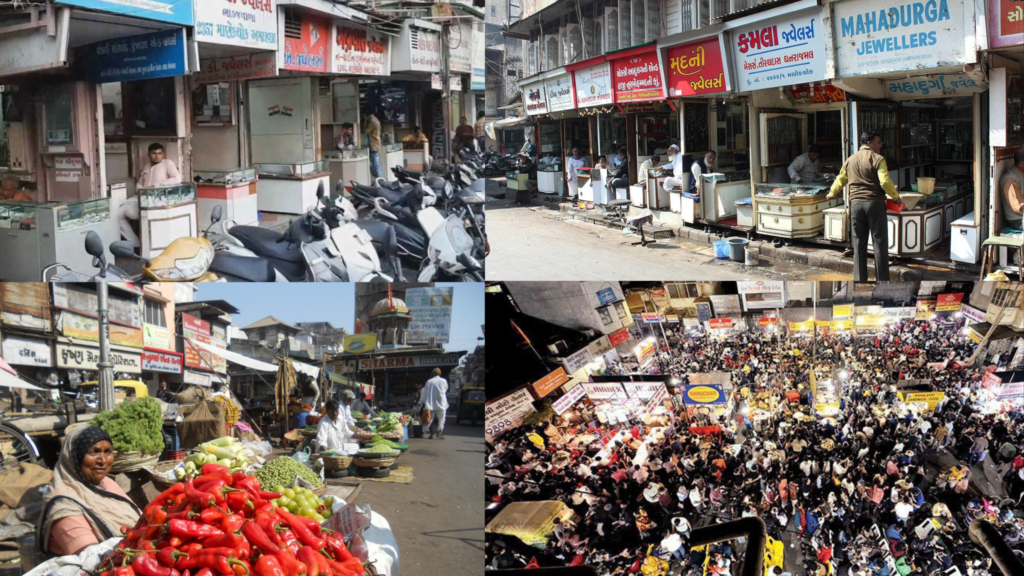
Manek Chowk’s physical setup also plays a quiet role. The market operates in phases throughout the day. Vegetables at dawn, bullion and jewellery trading through the afternoon, and by evening, it turns into one of the city’s most famous street food destinations. This rhythm keeps footfall constant and the area commercially alive around the clock, something a standalone showroom on SG Highway can’t replicate on its own. Buyers, brokers, and wholesalers know exactly where to find the trade concentrated, walkable, and unchanged for decades.
There’s also a practical layer: many of these shops are family-owned properties, often within pols that have belonged to the same households for generations. Owning the space outright, rather than paying premium commercial rent in a newer business district, keeps overheads low and margins healthier. Something that matters enormously in a business where prices move with global gold and diamond rates every single day.
Old City, New Money
None of this means Manek Chowk is frozen in time. Many families now run parallel operations. A modern office or showroom on SG Highway or in Bodakdev for retail and younger clients, while the real bullion and diamond trading, the part built on decades of trust, still happens from the old shop. It’s less about resisting change and more about knowing exactly which part of the business the old city still does better.
That’s the quiet story behind Manek Chowk: not a market stuck in the past, but one that never needed to leave in the first place.
[For more such updates around Ahmedabad’s food, lifestyle, café, and city culture, follow Inside Amdavad.]